A trademark is a distinctive sign that identifies goods or services in the marketplace. In Argentina, its registration and protection are governed by Trademark Law No. 22,362 and administered by the INPI (Argentina’s National Institute of Industrial Property). Find out what can be registered and what rights it grants.
The World Intellectual Property Organization (WIPO) defines it as “a sign or a combination of signs capable of distinguishing the goods or services of one enterprise from those of other enterprises.” If you are about to register a trademark, understanding the types that exist helps you choose wisely what to protect.
What can be a trademark
The INPI accepts words, combinations of letters and numbers, images, shapes, colors, sounds, and combinations of these elements. What matters is that the sign is distinctive: that it identifies the commercial origin of what you offer.
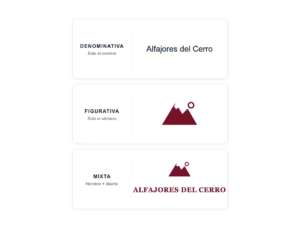
So-called traditional marks are the ones perceived by sight: words, letters, drawings, or symbols. There are three:
- Word mark — the name alone, without a design (for example, the name of your company).
- Composite mark — name + logo or graphic element.
- Figurative mark — the design alone, without words.

Word mark
It consists only of words, letters, numbers, or a combination of them, in standard typeface and without colors or graphic elements. It is the most widely used: it protects the name of the company or of a product phonetically and conceptually, regardless of how it is written. Examples: Audi, McDonald’s, Adidas, Apple.
Figurative mark
It protects a logo, drawing, or image, or a particular typeface and layout. Protection extends to the graphic whole, including the colors if they are filed. If the logo will be used in different colors, it can be filed in grayscale to protect the shape without tying it to a color; if a particular color matters, it is filed in that shade.
Composite mark
It combines a word element with a design, so it is identified both phonetically and graphically. A mark made up only of letters in a particular design is also a composite mark. It protects both the name and the design: examples include Netflix, Vans, Kodak, Lego, Coca-Cola, and IKEA.
Many companies combine a word mark registration with a figurative or composite one. To choose the one that suits you, see our guide word, figurative, or composite mark. In addition to traditional marks, there are non-traditional marks: three-dimensional, sound, or olfactory marks, among others.
What a trademark is not
A trademark is not the same as a patent or a copyright. A patent (Patent Law No. 24,481) protects technical inventions: a mechanism, a formula, a new process. Copyright protects creative works — texts, music, software, graphic designs — from the moment they are created.
Confusing these legal concepts is common and costly: you may have the name of your app registered as a trademark, but if you didn’t register the code as a work or protect its functionality with a patent, your legal coverage has gaps.
Why register with the INPI
Using a name in the marketplace gives rise to certain rights, but registration gives you a public title, a presumption of ownership, and concrete tools to stop imitators. Without registration, proving priority and scope in a dispute is much harder.
Next step
If you are defining your commercial identity, the first step is to check that the sign is available and to choose the right Nice classes. In the initial consultation — free of charge — we advise you on registrability and strategy. Contact us →
Keep reading: The trademark strength scale