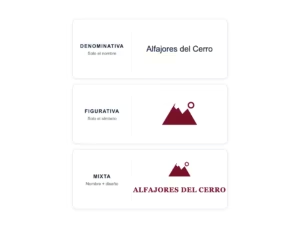
As we know, not all trademarks are equal, which is why a trademark’s strength matters so much commercially. Nobody wants their mark to be classed as weak.
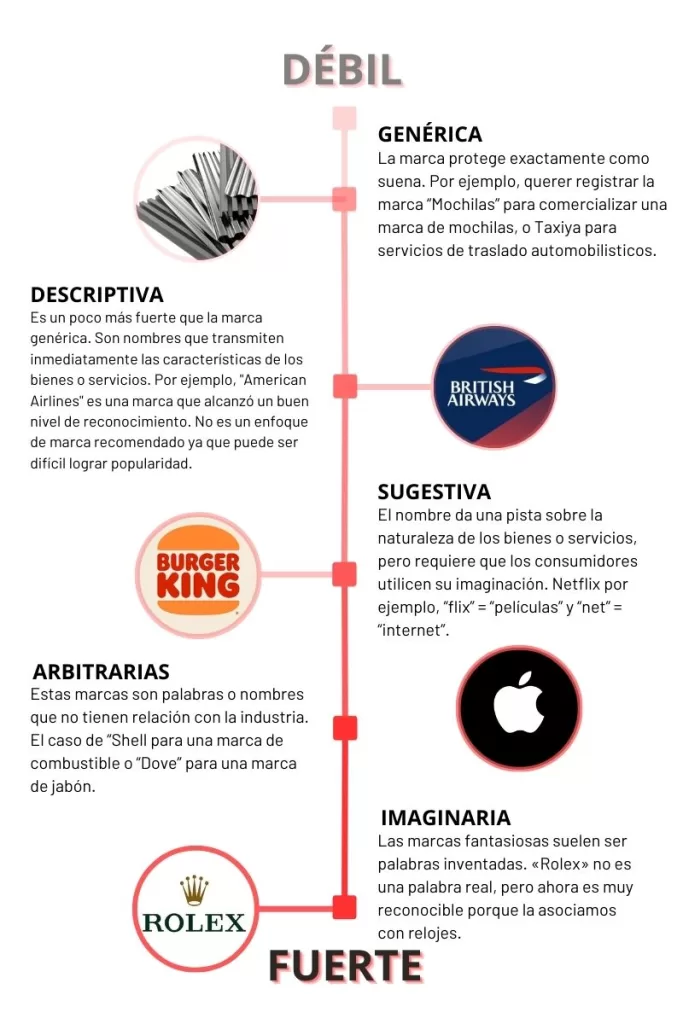
Knowing that this depends purely and exclusively on your choices when you select the name and register your trademark will help you make better decisions. This is how the scale of registered trademarks works, from weakest to strongest.
Generic
These are names that are the commonly known term for a class of products or services. They are related names, or the use of a unique (or the most common) term to describe a specific product or service.
- For example, if we wanted to register a trademark for selling books, “Books,” or for taxi services, “Taxis.”
No one can register this type of trademark. In fact, they have no strength at all and receive no protection because they are generic, common terms.
Descriptive
Names that immediately convey the characteristics of the goods or services. To register a descriptive name, you need evidence that, when consumers encounter the name, they can identify a single brand as the source of the product or service.
This category is somewhat more distinctive than a generic mark, but such marks are generally not as strong as suggestive marks.
- “Comfortable Clothing” could be a descriptive mark for clothing. However, most such terms cannot be accepted by the INPI (Argentina’s National Institute of Industrial Property) unless you can show that consumers recognize the mark as yours.
- A successful example of a descriptive mark is “Telefónica,” a trademark that has achieved a high level of recognition while bearing a name that describes its service.
However, this is not a recommended branding approach, since achieving that level of popularity can be difficult.
Suggestive
These marks give consumers a hint about the nature of the goods or services, but at the same time they require users to use their imagination to reach a conclusion about what the goods or services are.
Marks of this type have a much better chance of being protected through registration, particularly when they relate to their industry. One detail: a “mental leap” is needed to associate the name with the corresponding goods and services.
- “Netflix” is the best-known example. The registered trademark itself is not “movie streaming app,” but it lets consumers understand that movies, the “flix,” are available over the internet, the “Net.”
Another approach is to include terms such as “light” or “diet” in the mark, which hint that the products are low in calories.
Arbitrary and fanciful
Names that have practically no meaning in relation to the goods and services they are used with. Arbitrary or fanciful names are highly distinctive and tend to give trademark owners a good chance of registering their names successfully.
These are the two strongest types of marks. Arbitrary marks are words or names that have no relation to the industry.
- For example, “Shell” for a gas station, or “Dove” for a brand of soap.
Fanciful marks are generally invented words.
- “Rolex” is not a real word, yet it is not only recognized but also associated with watches. Without strong advertising, these marks would have no consumer recognition.
Even if you have a strong trademark, you must make sure it is different from anything else on the market. “Rolex” and “Shell” are strong marks because of their unique nature, but if every service station were called “Shell,” “Fish Shell,” and “Beach Shell,” the point of having a fanciful or arbitrary name would be lost, and the scope of protection would once again be limited.
The strength of a registered trademark is key
How strong is your trademark? For your trademark to be strong, it must be legally protectable. Arbitrary and suggestive marks can be protected. Descriptive marks must meet certain requirements before they can be legally protected. And generic marks can never be protected.
When you select your trademark, remember that the more imaginative and creative it is, the stronger it will be.
So, are you ready to register a strong trademark?
Related reading:
- Can you picture your strong trademark growing worldwide? How to take a trademark international.
- Messi beat Massi: a real-life example of trademark strength.
- Watch out: 5 reasons your trademark registration could be refused.