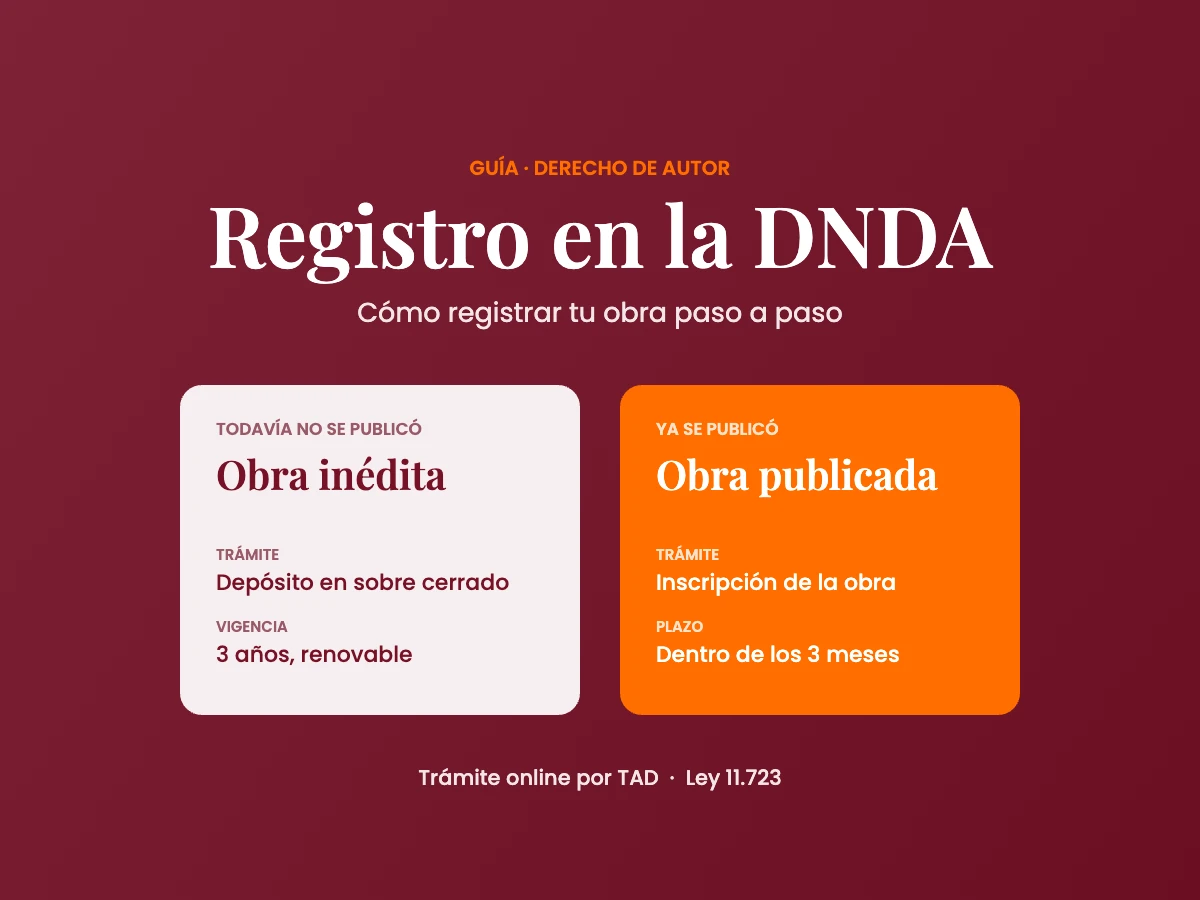
The DNDA (Argentina’s National Copyright Office) is the Ministry of Justice agency that keeps the National Intellectual Property Registry. Books, songs, software, scripts, photographs, and other works are registered there to obtain reliable proof of authorship and date. The procedure starts online through TAD (Trámites a Distancia, the government’s online filing platform) and, depending on the type of work, is completed by delivering the work in a sealed envelope, as physical copies, or in digital format.
A key point before you start: copyright arises when the work is created, not when it is registered. Registering it gives you proof with a certified date, which is what you will need if someone copies your work or disputes who the author is.
What the DNDA is and what it does
The National Copyright Office applies Copyright Law No. 11,723 (officially, the Intellectual Property Law). Among other functions, it:
- Takes unpublished works (works that have not yet been published) into custody.
- Registers published works: books, published music, phonograms, software, websites, and others.
- Records copyright agreements (assignments, publishing agreements, licenses), pseudonyms, and publishers.
Everything is handled through TAD with a clave fiscal (the tax authority’s login credential) of at least level 2. If the filing is made by a third party who is not involved in the work, that person must be authorized as a representative in TAD.
Which works you can register
Any original work expressed in some format: literary works (books, short stories, poetry, scripts), musical works (lyrics, music, or both), audiovisual, photographic, artistic, and multimedia works, websites, and software.
What cannot be registered is the idea: the law protects the concrete form in which you express it. The plot of a series cannot be registered; the written script can. If you want to dig deeper, we explain it in detail in what copyright protects.
Unpublished or published work: which registration applies to you
| Unpublished work | Published work | |
|---|---|---|
| What it is | It has not yet been published or disseminated. | It has already been published, printed, or disseminated. |
| Procedure | Deposit in custody: the work is delivered in a sealed envelope. | Registration: copies are delivered or a digital deposit is made. |
| Is it mandatory? | No, it is voluntary. | Yes: the publisher must register it within three months of publication. |
| Term | 3 years, renewable for equal periods. If it is not renewed, the deposited work is destroyed. | It does not expire. |
If a published work is not registered, the author’s economic rights are suspended until it is registered. At that point they are restored.
How to register a work with the DNDA, step by step
- Gather the details of the authors and owners: full name, CUIL, CUIT (Argentine tax ID numbers) or passport, address, email, and each one’s percentage of ownership.
- Pay the fee: each procedure carries a DNDA fee; published works also pay a levy to Argentina’s National Fund for the Arts. The amounts are updated, so it is best to check them when you start.
- Start the procedure in TAD: log in with your clave fiscal and choose the procedure that matches your work (for example, “Depósito de obra inédita” for an unpublished work or “Inscripción de obra publicada” for a published one).
- Complete the form and upload the documents: details of the work, the authors, and the owners, proof of payment and, where applicable, powers of attorney or additional documents.
- Keep the file number: TAD gives you a number and the cover sheets that accompany the work.
- Deliver the work: unpublished works go in a kraft-paper envelope, A4 size or larger, sealed and signed across the seals by at least one author or owner. They are delivered at the DNDA’s office in the City of Buenos Aires, by mail, or at the receiving offices in the provinces. Published works are submitted as physical copies or by digital deposit, depending on the procedure.
- Receive the certificate: if everything is in order, the DNDA issues the certificate through TAD. If there is an error, you receive a correction task so you can fix it.
If you are registering software
Software has its own procedures, both for unpublished and published works. For unpublished software, the copy goes on a CD, DVD, or USB flash drive inside the sealed envelope. If you also plan to license or assign it, see how a software license works.
If it is your first song
The DNDA has a free program, “Register Your First Song” (“Registrá tu primera canción”), for people aged 18 and over who have never registered a musical work: it allows you to deposit up to 15 unpublished songs, one time only.
What documents you need
- A clave fiscal of level 2 or higher to log in to TAD.
- Personal details and the CUIL/CUIT of each author and owner.
- Proof of payment of the fee (and of the National Fund for the Arts levy, if the work is published).
- The work: in a sealed envelope (unpublished) or as physical copies or a digital file (published).
- If you are acting on behalf of someone else: a power of attorney in TAD, the company’s bylaws, or documents proving the relationship (for example, for a minor or a deceased author).
How long registration takes
Filing in TAD takes a few minutes. The DNDA does not publish an official timeline for issuing the certificate: in our experience, it is issued about two weeks after the office receives the work and reviews the documents.
For unpublished works, note the expiration date: renewal can be requested up to 30 business days after the deposit expires.
Common mistakes when registering with the DNDA
- Trying to register an idea: what is registered is the concrete work, not the concept.
- Not renewing the deposit of an unpublished work: it expires after 3 years and, if it is not renewed, the work is destroyed.
- Leaving out co-authors or percentages: this later becomes the main source of conflict between authors.
- Confusing copyright with trademarks: the DNDA protects the work; the name of a band, a publisher, or a saga is protected as a trademark with the INPI (Argentina’s National Institute of Industrial Property). That is what trademark registration is for.
- Publishing without registering: for published works, the three-month period runs from publication.
Frequently asked questions about the DNDA
For unpublished works, no: copyright exists from creation and the deposit is voluntary, although it gives you proof of authorship with a certified date. For published works, Law No. 11,723 requires registration within three months, and if they are not registered, the economic rights are suspended until they are.
The deposit in custody lasts 3 years and can be renewed up to 30 business days after it expires. If it is not renewed, the deposited work is destroyed, so it is wise to put the date in your calendar.
Yes. The procedure is started and tracked through TAD with a clave fiscal. Depending on the type of work, it is completed by delivering the work in a sealed envelope or as physical copies, or through a digital deposit.
If it has not been published yet, as an unpublished non-musical work, in a sealed envelope. If it has already been published, as a published work, with the copies and the details of the edition. In both cases the procedure starts in TAD.
The DNDA protects the work (the book, the song, the software). The INPI protects the signs that identify goods or services, such as a trade name. A single project may need both registrations.
Registering your work is the first step toward being able to defend it. At Eguía we handle the entire procedure for you, acting under a power of attorney in TAD and including delivery of the work. If you are not sure which procedure applies to you, contact us: your first consultation is free.
Written by Clara Eguía, partner at Eguía Marcas y Patentes